Where the River Dreamed a Shape

Mythology is like a vehicle. It
helps us to travel in deep time
back and forth. Like a vinyl
record, we can choose a track,
go back and forth or in a loop.
It’s a circular way of looking at
time; it’s not linear, and often
it’s not common when we are
accustomed to thinking
in terms of progress and
linear time.
Emilija Škarnulytė
Defne Ayas: Dear Emilija, I wanted to ask about the hybrid, serpentine figure – part woman, part water-being – channelling both pre-Neolithic symbolism and post-human imaginaries. She doesn’t appear as an ancestral relic, but as an ancestral frequency, coiled within the body’s tidal memory. Slippery, shape-shifting, memory-wrapped. A form that carries myth as muscle, water as witness, fluidity as knowledge. She swims between myth and algorithm, whispering lost codes. Not binary. Not static.

Emilija Škarnulytė, Lightbox Ouroboros, 2023. Image courtesy of the artist
Emilija Škarnulytė: Hi Defne! Thank you for diving into this riparian journey together. The goddess-like figure first rose from the water – shaped by its watery abysses and by my own surrender to their embrace.
The recent trilogy of films – Æqualia, Riparia, and Xirasa – forms an imagined pantheon of goddesses that I filmed in various confluences of rivers, some of those places historically used for resource extraction, but my enquiry is to explore their deeper meaning as places that nurture life.
I set Aequalia (2023) where the muddy Rio Negro converges with the Solimões River in the Amazon Basin. The Rio Solimões is from glacial melt, its bright milky colour forms from all the silts and rich clay from way up in the Andes. And the Rio Negro is dark and muddy with all decay of the lowland forests it flows through. Seeing where they confluence together is dramatic, stark. The difference in colour is the most obvious, but also temperature and composition of the two, flowing side-by-side for six-kilometres before they finally and fully blend and two streams become one. There, I was crossing through the confluence with my own body.
In Riparia (2023), I focus on the descent of water from Swiss mountain dams through the Rhône River until it flows all the way down to the Mediterranean.
And Xiraxia (2023) was filmed in Spain, down in the wetlands of the Lower Guadalquivir region, the Odiel marshlands, and the Tinto River, and across three provinces: Huelva, Seville, and Cádiz, all in Andalusia.
I showed all three films recently in a solo exhibition at Kunsthall Trondheim called ‘The Goddess Helix’. In the series, I summoned this mythical, serpentine figure. This chimaera, part-human, part water creature. She’d guide people through the currents, taking them from the present into Neolithic, subterranean spaces.
I was especially drawn to the work of Lithuanian archaeologist, Marija Gimbutas (1921–1994), who developed this theory she called ‘archaeomythology’. Very controversial at the time, she hypothesised that peaceful and matriarchal societies thrived along rivers in Neolithic Europe before the arrival of the Proto-Indo-Europeans. And their goddess figurines were one of their few remaining visible traces. From her perspective, rivers were transformed from sites of worship to sites of extraction and conflict.
DA: How is the serpent performing the feminist infrastructure? Is the body a portal, an oracle, or a vessel for the more-than-human? Does the goddess reside not just in the past, but also stir the future? Through Gimbutas’ feminist archaeology, how did the serpent-goddess offer a strategy for challenging patriarchal timelines? And in light of the dark forces currently at play in the United States, aren’t Enlightenment frameworks of knowledge already ripe for unravelling?
Adam Kleinman: First off, I am not an expert in these matters. From my limited understanding, serpent iconography in human culture has been used as an abstraction of the course of a river by riverine communities, or to put it another way, they are symbols of rivers developed by cultures who likewise flourished along river systems.
Rivers themselves are, of course, life-giving forces. They provide drinking water, food in the form of fish, and are used for crop irrigation, navigation, trade, and industry. They also serve purposes such as washing, entertainment, and the provision of materials like shells for tools and decoration, among various other things. Yet they also unleash destructive floods and cause drownings, so they embody both creative and destructive forces.
Serpents mirror this duality. They slither in patterns resembling a river’s meandering course, provide food and decorative skins, but can also deliver deadly venom. Snake venom can serve as a medicinal agent in certain contexts, further blurring the line between harm and healing. The snake’s ability to shed its skin has also been used in various cultures to symbolise regeneration, echoing how river waters connect to cycles of renewal and the nurturing waters of the womb and so forth.
Rather than viewing these symbols through a gendered binary, we might better understand them today as ‘queer’ in the sense of being ambivalent – neither purely life-giving nor death-bringing, but holding potential for both depending on context. Not one thing or its other. They are ‘both/and’ states of being, not either/or things. They represent phenomena whose meaning shifts not only based on the context itself but also on our human capacity to listen, understand, and establish that context.
EŠ: All beautifully said Adam! For me, after studying Marija Gimbutas’ archaeomythology, the serpent-goddess emerged as a very powerful symbol that defies binaries. Femme, but not trapped or defined in either the male or female. Embodied, psycho-spiritual, and geological. Peaceful matriarchal societies revered the goddess in her many forms – fertile, fluid, hybrid. She was their world, both in their literal environments but also spiritually, becoming central to many of their rituals.
In my films, storytelling is especially important because it allows me to point out hidden ancient knowledge broken and scattered by patriarchy for hundreds if not thousands of years. However, like a sunken ancient city, it’s hiding, sleeping just beneath the surface.
The goddess is not a relic, but a circular force – stirring the future, carrying knowledge of alternative codes, reactivating what was buried or discredited. She is a guide.
For sure I’m not claiming the serpent to be a universal performance of feminist infrastructure as each goddess is often very site-specific. They raise more questions than they answer.
The landscapes captured in my films – wetlands, marshes, ancient astronomical sites – are places where mythology and geology meet. They carry the traces of knowledge and ritual, but have also been twisted by systems of control, extraction, and erasure.
There are more goddesses to come, I will unfurl a few more in my solo exhibition at Tate St. Ives in the UK, coming up this fall, 2025. The divine feminine is diverse and transformative, it has been exciting to explore a few of its many forms. So far, eight goddesses live in the pantheon: Sofia (2025), Tethys (2024), Xirasia (2023), Hypoxia (2023), Riparia (2023), Æqualia (2023), Rakhne (2023), Sirenomelia (2017).
DA: Are you suggesting that myth and science are not oppositional, but interdependent ways of knowing? How might viewers re-learn ancestry within this molecular mythos? How do we tunnel under chronology, open thresholds?

Emilija Škarnulytė, Burial, 2022 (film still). Image courtesy of the artist
EŠ: Mythology is like a vehicle. It helps us to travel in deep time back and forth. Like a vinyl record, we can choose a track, go back and forth or in a loop. It’s a circular way of looking at time; it’s not linear, and often it’s not common when we are accustomed to thinking in terms of progress and linear time. So myths are like time capsules, helping us to explore and manifold ways of looking at time and space.
Sun Ra, who I admire, said in his book of poetry, Prophetika Book One: ‘If you are not a myth, whose reality are you? If you are not a reality whose myth are you?’
Myth plays a crucial role in survival. It offers a lens through which we can understand and navigate the complexities of the human experience. My focus lies in the liminal space between both worlds – the confluences, the thresholds where only shape-shifting beings can pass through portals.
Goddesses appear in the in-between, those liminal places. At the confluence of material and mythic, anthropological and geological. These deities flow out of ancient rivers and marshes. And now I see them coming out of the rivers of data. And since I’m looking most specifically these days at things like climate modelling and the flows of surveillance, I’m seeing them rise from here too.
I want my camera to be like an archaeologist’s tools, scraping away the layers of dirt, the stratas of accumulated time. Piercing the dirt, but also the cosmic, the geologic, the ecological, and the political. Immersive experiences move away from seeing the universe from only a human perspective. The Earth tells its own stories. I’ve been filming deep under Earth, observing uncovered traces of humans in very unexpected places. It’s not just human and non human though, it’s also beyond human. Even in all the fanciest and newest models and structures of science, I already see their ruins. In this context, the hybrid being I summon is not a static relic of the past, but truly a vessel of unfinished histories. Spectral but also absolutely alive.
I do extensive research. I talk with scientists and local communities. And I use my own body to measure sites as a measure. And these are the quiet foundations of my work. Often, it is the location itself, whether that’s a political border or a geological stratum, that takes the main role.
It’s also important in my work to talk about the very concept of progress and technological advancements as speculative. Distance from current ideologies is critical in engaging with all these strata. What we build is not only just its intended purpose. And yet it is treated as such. We should leave room for doubt. How was a core sample taken? Is it a human perspective treated as central, or someone else’s?
AK: Let’s turn this around a bit and discuss scientific myths. Instead of privileging myth over science, or vice versa, there is also a form of bias today which needs to be discussed. Forms of bias contaminate ‘science’ and create false claims masquerading as objective, correct, or whatever term you want to use. This can be seen in how medical science has created myths, for example, that Black people, particularly Black women, have higher thresholds for pain (which is bullshit), and thus receive less empathetic medical care including not being believed or listened to as well as not receiving treatment, drugs, or anesthesia, or the idea – also in medicine – that a fully male sample set, studied by male doctors, can be extrapolated to the general public. This is a myth of the ‘universal’. These kinds of myths, particularly as they work in the applied sciences and technology, can be dangerous. These issues also extend to broader questions of bias, but there is an urgency to correct these blind spots – particularly in care and digital technology, where AI, for example, is being trained on monocultures – as soon as possible.
Science and gender theorist Martha Kenney has explored this in her work on ‘scientism’ in the biological sciences, a phenomenon where scientific authority is invoked uncritically to make claims appear more objective than they are, often obscuring underlying social and political values behind a veneer of neutrality. This ‘scientism’ tends to silence other ways of knowing and perpetuates harmful assumptions under the guise of objective fact.
These false beliefs are ‘myths’ which need to be reflected upon critically, and are ‘myths’ in the pejorative sense. The recently deceased Nobel laureate Daniel Kahneman popularised the need for greater rigour in evaluating analytical claims through his concepts of thinking fast and thinking slow, or playing intuitive versus analytical rigour off each other better. His is another voice calling for science to be more critical of itself and acknowledge various confirmation biases, power assumptions, etc.

Emilija Škarnulytė, Riparia, 2023 (film still). Image courtesy of the artist
DA: Is ancestry ecological, not just genealogical? Do stories root us? What role does storytelling play in preserving not only memory but also biodiversity? In your recent works, we witness ecology as ancestral memory and mourning as a form of activism.
EŠ: I’m really interested in finding those liminal spaces in-between the biological, the geological, even the whole cosmos, and piercing them so we can look inside, connecting them like chambers in caves.
For instance, in Hypoxia, the story ties together a lot of different threads: the Baltic Sea anomaly, a supposed spacecraft at the bottom of the sea, and this anthropogenic phenomenon of hypoxia., i.e., the oxygen depletion that causes dead zones to appear in seas, as well as the Lithuanian sea goddess, Jūratė, and her dalliance with a human. Myth meets science and science fiction beneath the waves and shape shifts.
DA: How do you metabolise extinction? Does each work also speak a breath of resurrection? Or is extinction itself a mythic space?
EŠ: Extinction is not an end point – it’s a threshold.
It’s where something dissolves, and something else, perhaps less visible, begins to take form. In this way, extinction is not something to be reversed, but rather to engage with in dialogue. My work often navigates these liminal spaces – between death and transformation, decay and resonance.
And extinction, like myth, confronts our standard notions of time. It compresses deep geological epochs into a single breath. The ruins of nuclear plants, submerged cities, vanishing species – these are all ghosts that remain with us. That loss reverberates, reshaping the present into an elegy.
Resurrection is a ripple. A question left unanswered. Extinction becomes a mythic space because it is a story we haven’t finished telling yet. These stories get encoded in stone, in ruins, in river beds, in silence.
By October 2023, just a year after I finished filming Æqualia, the Encontro das Águas ran dry due to severe droughts, resulting in the mass dying-off of the botos. I’d filmed them and swam with them and now most of the botos there are gone. Storytelling is not just about preserving what was, but about imagining what could still be, beyond the perceptual limits of our species.
AK: Art is an act against oblivion; however, I sure hope any future alien archaeologist who may find our stuff long after we’re all dead has a sense of humour. Perhaps there is a black comedy solution to the Fermi paradox – that intelligent civilisations invariably evolve toward their own destruction, leaving behind only artefacts and art as testament to their existence.
As a thought experiment, let’s consider what kind of museum didactics these future alien curators might make: ‘Homo sapiens were clever enough to split the atom, but not quite clever enough to realise that wasn’t always the best idea’, or ‘this exhibit includes humanity’s most advanced technology: digital devices used primarily to share pictures of cats and argue with other humans.’ This kind of critical distance might be able to help us analyse ourselves today, which was the purpose of projects like The Last Pictures by Trevor Paglen, which revisited the Golden Record sent out on the Voyager 1 and Voyager 2 spacecraft; its claim? That the Golden Record wasn’t only about communicating with aliens, but an exercise in how we represent ourselves.
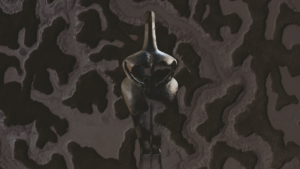
Emilija Škarnulytė, Xirasia, 2023 (film still). Image courtesy of the artist
DA: Adam, we love the sacred, the political, the ritual. Art attunes us to Earth’s dramaturgy and ritualises our reckoning. How do you write, dream, and by extension, curate and channel?
AK: True story. I was just speaking with a friend who set up a gallery in LA. He was originally a music producer, and the move into visual art was a new transition. On a get-to-know-each-other walk around a playground near his gallery, he said something to the effect of ‘what’s up with studio visits; they’re so weird! You go, and two people just try to outsmart each other, but no one knows what they’re talking about, and it’s like this very awkward performative sizing-up. In the music studio, you hang out, make music, and when you know something is working, you turn to each other, smile, and say “this is a vibe”.’ In reply, I said, ‘I try to only work with artists in the way you’re talking about music’ and said, ‘that’s why we’re taking this meeting as a walk :-)’
DA: As we navigate ecological catastrophe, what can art, film, and performance still do? If art is the Earth dreaming through us, birthing new rhythms of sense-making, how does performance and art reflect, or even mimic, the Earth’s own theatre and drama?
AK: You can’t make change if you don’t have a vision of what you’re building. Art, or for that matter, imagination, is necessary as the place to dream, to inspire, to create hope, etc., but it’s insufficient alone. I don’t want to get into the tricky process of concrete action, causality, etc., as there is not enough space here for that. What I think gets forgotten, though, if we’re going to talk not only about vision, but about actual leadership, is that one person’s utopia is another’s dystopia.
Activist thinkers across the socio-political spectrum are not immune to the failure to recognise whose voices are excluded from their imagined futures, creating ‘perfect worlds’ that end up reinforcing power structures under a veneer of some progress. Effective political visions must therefore not only inspire but also interrogate their own blind spots and limitations. Or said in another way, how can art (here a stand in for vision) and most importantly, its display and address meet people where they are and ‘build the tent’? This question of leadership is lost today, as I tend to see the discourse wanting to evoke authority, particularly moral authority, which is turning many off.
DA: Emilija, your works feel more like spells. How did the exhibition become a rite, an opening, a shedding?
EŠ: In a ceremonial space, time shifts, really everything shifts. The ceremony is a portal between realms. Maybe that’s why you conceive of the work as a ‘spell’. My films, installations and performances are portals to otherwise inaccessible or hard to reach sites – Etruscan caves, sunken cities, nuclear power plants, neutrino observatories, and aphotic zones located four kilometres beneath the ocean surface, where no sunlight penetrates. My hybrid creatures serve as guides through these thresholds. Shapeshifters, psychopomps. The portals can be opened.
AK: It’s just a start (and not the finish). And to start something, you need two things: an invocation (which is a form of acceptance and acknowledgement) and a leap of faith (which is the will).
Emilija Škarnulytė is a Lithuanian-born artist and filmmaker. Working between the realms of the documentary and the imaginary, Škarnulytė makes films, sculptures, drawings, and immersive installations exploring deep time and invisible structures. She works in realms that range from the cosmic and geological to the ecological and political. In her emerging cosmology, she binds the ancient and the future through the mythological. With a future archaeologist’s perspective, the artist’s films take us into decommissioned nuclear power plants and deep-sea data storage units, forgotten underwater cities, and uncanny natural phenomena.
Adam Kleinman creates exhibitions, performances, and other projects that inspire trust and mutual understanding by presenting art that reflects the daily realities and lived experiences of individuals and communities. Through his curation, Kleinman opens up diverse access points to art, enhancing the joy of everyday life by bringing people together to share powerful ideas expressed with beauty and purpose. His recent projects include monographic exhibitions of artists such as Gala Porras- Kim, American Artist, Emilie Louise Gossiaux, and Sin Wai Kin. As Director and Chief Curator of Kunsthall Trondheim, he continues to promote meaningful engagement with the arts.



