Crack Nerve Boogie Swerve
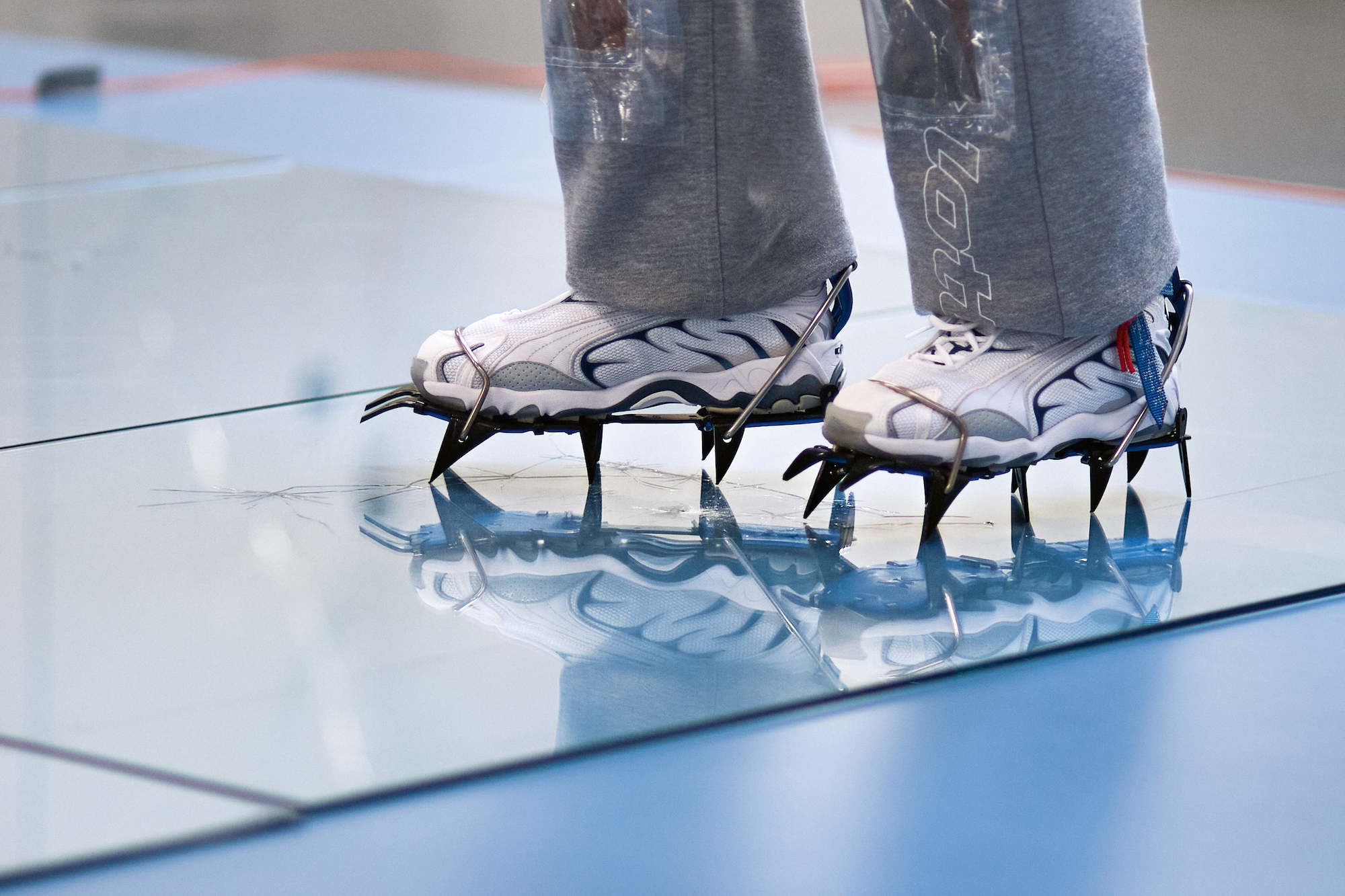
Like the human body, [glass]
is extremely fragile yet
extraordinarily strong,
depending on how it is handled.
Alexis Blake

Alexis Blake, Crack Nerve Boogie Swerve, 2019. Performance series and installation, TENT. Rotterdam, The Netherlands. Photo: Diana Oliveira, re-touch: Thijme & Szafrańska
Crack Nerve Boogie Swerve focuses on: transparency as both revelation and concealment of power (glass as barrier and opening), resistance emerging through bodies and materials that refuse confinement, resonance as frequencies that create collective transformation, and breaking as the ongoing movement between states of being, liberating bodies from oppressive norms and institutional limits.
*First developed in 2019, I created an installation and a series of experimental performances in different acts where the exhibition space of TENT in Rotterdam was used as the process space of making the work. In 2023, a comprehensive performance was developed and presented at KW Institute for Contemporary Art in Berlin, followed by an iteration on the High Line in New York City. The evolution at WIELS in Brussels in 2024 introduced the archive – a deliberate acknowledgement of past iterations while creating a vantage point to consider a future trajectory. The work was transformed again into a performative exhibition comprising new sculptural works, a performance series and a large-scale installation with a sound and light composition that captured its past iterations while slowly morphing into something new. Fluid and ever-changing, Crack Nerve Boogie Swerve was never intended as a fixed moment in time, but rather as a scaffold designed to stage further development.
I. MOLTEN MEMORIES
While investigating the notion of breaking, I arrived at the materiality of glass because it is amorphous – neither liquid nor solid, constantly in a state of being in-between, always changing. Glass works congruently with the notion of breaking because it defies and resists structures that try to confine it into a unified form. Like the human body, it is extremely fragile yet extraordinarily strong, depending on how it is handled.
Glass occupies a liminal space between ‘whole’ and ‘broken’. When ‘broken’, it assumes a state of apparent uselessness. This perceived fragility extends beyond the realm of materiality into socio-political spheres. Breaking can be a means to oppress or break oppression. The act of ‘breaking’ places individuals between conflicting forces, creating tension between oppression and liberation. Within these power dynamics, moral clarity becomes elusive – what looks like liberation to some appears as oppression to others. ‘Breaking’ can assume multiple interpretations that constrict and distort meaning. A rock hurled through a shop window may be read as a sign of defiance or criminal intent. When interpreted as a criminal offence, such broken windows are frequently linked to fabricated narratives of urban and societal decline – a notion underscored by the ‘broken windows theory’, which has been used to legitimise over-policing and oppression of Black and Brown communities in the United States. Public protests can be construed as acts of change or disruptive agitation. Demonstrations of solidarity may be praised as either noble gestures or dismissed as disingenuous posturing. This ongoing tug of war brings underlying conflicts to the surface, emphasising the precarious balance upon which societal cohesion teeters.
Crack Nerve Boogie Swerve explores the nuanced meaning and act of breaking through sound, voice and body in an installation made of glass and steel. Glass becomes a performer as much as a metaphor for the individual and collective body. It isn’t passive material, but an active participant that affects and is affected by the performers and audience. As performers engage with the glass structures, the glass shifts – border becomes window, window becomes mirror, mirror becomes instrument – ultimately sounding under the hands of a percussionist.
Building on this relationship between glass and body, in 2024, I developed new sculptural works that are impressions of bodies moulded from glass plates. These facsimiles serve as visual representations of movement that evoke the multitude of micro decisions that build up the kinetic flow of a single action. Aesthetically, these sculptures engage with the malleability of glass, metaphorically straddling the line between resilience and fragility that defines both material and flesh. Each mould captures a distinct body part mid-motion, which details moments of exertion and fixes them as relief sculptures on the surface of the glass. Thus creating a tension between the work’s emphasis on fluidity and these moments crystallised in time. These body impression works, along with the broader sculptural investigations that have evolved since 2019, extend into the performance work where bodies and materials together constitute Crack Nerve Boogie Swerve.

Alexis Blake, Crack Nerve Boogie Swerve, 2019. Performance series and installation, TENT. Rotterdam, The Netherlands. Photo: Diana Oliveira, re-touch: Thijme & Szafrańska.
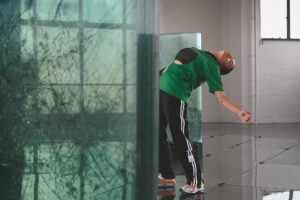
Alexis Blake, Crack Nerve Boogie Swerve: the archive, 2024. Installation and performance series, WIELS, Brussels, BE. Photography: Bea Borges
II. BODIES ATTUNING
Each iteration brings together a locally rooted performance team of women and non-binary persons – percussionist, low frequency sound artist, producer/ DJ, and four to six dancers from diverse dance backgrounds, including: tap, breakdance, hip-hop, house, Afro-fusion, contemporary, heels, and ballet. Working with a diversity of local dancers reflects the living dance genealogies of each city, while honouring the communities and histories that shape local movement languages. Many of these dance forms emerged from conditions of extreme oppression, such as Hip Hop and breakdancing (quintessentially embodying the notion of breaking) in the Bronx during the 1970s amid economic abandonment and systemic neglect. These forms became acts of resistance through expression and joy, creating spaces of agency within systems designed to deny it.
Part of the choreography in Crack Nerve Boogie Swerve interrogates how gender codes embedded within dance genres create embodied forms of confinement. Ballet exemplifies this through its rigid separation of ‘feminine’ and ‘masculine’ movement vocabularies, binding dancers to prescribed expressions that reinforce binary gender hierarchies. Therefore, the work explores how these prescribed boundaries might be exposed, questioned and broken through collaborative cross-pollination between forms.
Working with the same core sonic collaborators – percussionist Sofia Borges and low-frequency sound artist Stefanie Egedy – across multiple iterations allows for a deeper engagement with the glass, sound scores, dancers and the spaces in which we perform. Rather than starting from scratch each time, this continuity enables us to discover new resonant frequencies and push the boundaries of what the material can do.
The steel elements supporting the various glass plates are mounted on wheels. They are designed to be moved and manipulated by the performers. This mobility creates shifting perspectives and fluid relationships between performers and audience, allowing the choreography to adapt to different spaces while maintaining its essential structure. The wheels become part of the work’s refusal of fixed positions.
The dancers individually and collectively engage the glass with their embodied power, channelling anger, rage, defiance and frustration into hyper-focused actions of expression that crack the glass. The glass never shatters, maintaining its form while bearing the traces of the dancers’ movements and actions, creating a visual record of resistance that transforms through unity rather than uniformity. The performers explore the somatics of prescribed gestures of dissent and resistance while using their voices to respond to and cut through the frequencies in the space. A live dialogue emerges between percussionist, dancers, and sound artist, who samples the percussionist’s frequencies in real-time, creating a synergy among all performers that amplifies their collective resonance.
Central to Crack Nerve Boogie Swerve is taking each performer’s distinct form of expression as a starting point for collaborative exploration – probing how to learn from, come close to, and empathise with one another. The aim isn’t appropriation or homogenisation of the different sonic and body languages, but rather using the glass as a communicative tool – a shared medium through which performers can break patterns, learn, and collectively create new vocabularies of sound and movement without losing their subjectivities. This collective attunement between performers creates the conditions for the work’s deeper investigation of how resonance itself becomes a transformative force.

Alexis Blake, Crack Nerve Boogie Swerve, 2019. Performance series and installation, TENT. Rotterdam, NL. Photo: Diana Oliveira, re-touch: Thijme & Szafrańska.
III. FREQUENCIES OF CHANGE
Resonance – a key notion of the work explored through the emanating frequencies of the glass, environment(s) and performers’ bodies. Commonly, one thinks of the force, impact, and velocity that it takes to break something. However, resonance offers another kind of break – one that moves through by tuning into the material’s own rhythm. Rather than destruction through collision, resonance operates by finding the natural vibrations within materials and amplifying them, thereby transforming them into their most vibrational state – not breaking them, but revealing their capacity to change and become something new.
In Crack Nerve Boogie Swerve, resonance functions at multiple scales simultaneously. The percussionist, Borges, activates the glass’s various resonant frequencies through direct physical contact – striking, rubbing, engaging with the glass, transforming the sculpture into a musical instrument. Meanwhile, sound artist Egedy responds by playing the SL–SUB subwoofers, using very low frequencies that interact with the architectural resonances of the space itself. Low frequencies travel through space, move through walls, bodies, objects. These subsonic vibrations operate below the threshold of conscious hearing, felt rather than heard, essentially playing the building as an instrument and finding how the room wants to vibrate.
This creates a cascade of resonant relationships: the glass resonates under the percussionist’s touch, the architecture resonates in response to the subbass frequencies, and all the bodies in the space – performers and spectators alike – become part of this interconnected resonant system. The heavyweight subwoofers put to the test not only the glass material but also the entire structural framework. Their impact reveals the porosity of boundaries we typically perceive as solid and separate. They shake the buildings. (For example, when performed on the High Line in New York City, the subs were so powerful that an entire building evacuated because they thought it was an earthquake.) What emerges is a dialogue between immediate resonance (glass), environmental resonance (architecture), and embodied resonance (the bodies within the space), where each element amplifies and responds to the others.
This layered approach to resonance mirrors the work’s larger political implications of how systemic change might unfold. Rather than sudden rupture, frequencies operate at different scales – from the intimate to the structural to the collective – finding natural stress points in seemingly rigid systems and coaxing them toward transformation. The subsonic frequencies create what writer and scholar Sara Ahmed describes as encounters that move bodies before conscious thought can take hold. These are visceral responses that bypass rational processing and directly impact the body’s capacity to be oriented and reoriented. In this vibrational field, bodies become attuned to each other through shared resonant experience, creating atmospheric conditions where feeling spreads between performers and spectators alike. The work operates through affect, generating possibilities for political and social transformation that emerge not from conscious decision-making but from the body’s immediate, felt response to being moved by frequency itself.

Alexis Blake, Crack Nerve Boogie Swerve, 2023. Performance, High Line, New York. Photo: Liz Ligon
IV. NEITHER/NOR
These resonant encounters – sonic, social, and embodied – point toward the work’s larger refusal of fixed positions. Rather than arriving at a resolution, Crack Nerve Boogie Swerve persists as an ongoing interrogation – a framework that continues to generate questions about the spaces between transparency and opacity, resistance and compliance, liberation and oppression, and what is deemed ‘whole’ and valuable versus what is perceived as ‘broken’ and worthless. The work refuses the false comfort of fixed states, and instead dwells in the frequencies that emerge when these seemingly opposing forces encounter one another. Through resonance, both sonic and social, the performance reveals how breaking need not be an endpoint but a continuous process of becoming, where bodies, materials, and systems discover their capacity to vibrate differently. Each iteration exposes new fault lines in oppressive structures, while the glass – neither liquid nor solid – remains a testament to other ways of being. In this vibrational field, empathy emerges not as emotional identification but as a shared resonant experience, where bodies learn to attune to each other’s frequencies without losing their distinct languages. The work does not offer answers about power, freedom or transformation, but rather creates conditions where these concepts can be felt, questioned, and rearranged through collective embodied experience. In this perpetual state of breaking and remaking, transparency becomes not merely about revelation but also permeability – the acknowledgement that boundaries are more porous than they appear. Don’t get me wrong, sometimes you gotta break shit. But resistance can also emerge from resonance itself, and liberation might be found not in the outcome but in the ongoing movement between states of being, where empathy operates as a form of radical listening that makes transformation possible.
Alexis Blake’s multidisciplinary practice coalesces visual art, performance and dance. She investigates the way in which the body is represented and treated as an archive, which she then critically examines, disrupts, and re-negotiates. Her work directly engages with the representation and subjectification of gendered bodies while activating them as sites and agents for socio-political change. In doing so she creates languages of resistance and spaces to expose and elude systems of power.



