Every Body Knows

Bodies are not isolated vessels
of personal experience –
they’re shaped by social
structures, influencing how
we engage with the world.
Moriah Evans
Dance has long been a powerful tool for protest and political activism. Now, in its 11th edition, the Performa Biennial in New York unveils a new programme dedicated to a movement school that explores this subject. Defne Ayas, Senior Program Advisor and Curator-at-Large, and Kathy Noble, Senior Curator at Performa, interview the choreographer Moriah Evans, who is shaping the programme.

Moriah Evans, Configure, 2019. The Kitchen, New York. Pictured: Lydia Okrent, João dos Santos Martins. Photo: Paula Court

Moriah Evans, Configure (2019, The Kitchen, NY). Pictured: Lizzie Feidelson, Nicole Mannarino, Lydia Okrent. Photo: Paula Court

Moriah Evans, Configure, 2019. The Kitchen, New York. Pictured: Lydia Okrent, Nicole Mannarino, Lizzie Feidelson. Photo: Paula Court


Kathy Noble: Moriah, your practice has such a deep focus on the body, movement, and relational dynamics. How do you see these practices shifting our understanding of not just individual embodiment but also how we engage with others through our physicality?
Moriah Evans: The body is not just a vessel for personal experience – it’s a mirror to the larger social structures we live in. I see it as something deeply informed by both visible and invisible forces: our cultural conditioning, societal norms, political climates, and even the histories of violence and care that our bodies have witnessed. This is central to my practice. I work with relational dynamics and movement, focusing on how we engage with one another not just through words, but through embodied experiences. The movement itself becomes a tool for expressing and shaping these relationships. It’s a way to rethink how we come together – not just in dance, but in any communal act.
Defne Ayas: And your work has always brought an innovative approach to dance, where the body becomes both the instrument and the site of deeper, socio-political engagement. I’d love for you to elaborate on how you see the body as a vessel for both personal and collective memory, and how it shapes the way we relate to others.
Moriah: Let’s claim the studio as a space for gathering, a place for exchange rather than just solitary work. Bodies are not isolated vessels of personal experience – they’re shaped by social structures, influencing how we engage with the world. So, for me, I am always trying to make space for that relational, embodied experience in ways that invite others to move with us, not just watch from the outside.
KN: That leads me to your concept of the ‘radical studio’, where the body is not simply moving but living. Can you talk a bit about how you envision this space transforming the practice of dance and its relationship to the world around us?

ME: My idea of a radical studio goes beyond just the physical space where people move. It’s a site for collective energy and transformation – a place where dance, politics, and care can merge. This studio isn’t only about rehearsing steps; it’s a space for enduring the world through embodiment. It’s about recognising that the body is not neutral – it is a site of action, struggle, imagination, and possibility. For me, the studio hosts a diverse range of practices – movement classes, somatic work, healing arts like Qi Gong and Feldenkrais, and also discursive spaces where ideas around consciousness and embodiment are discussed. The studio becomes an expanded space for radical presence, where everyone’s body and its movement hold the potential for collective transformation.
DA: I love the idea of dance as a space for living, not just for performance. You’ve mentioned before that you see the studio as a space for both individual and shared experience. Could you expand on how this ties into your exploration of embodied practices as a form of radical togetherness?

ME: I’m interested in the studio not just as a space for personal exploration but as one for shared, collective energy. Dance and movement can be intensely personal and quite subjective in terms of a kinesthetic experience, but when we come together, that energy shifts and becomes a collective force. It’s not about performing for an audience – it’s about inviting the public into the experience of being in the body, of moving, of feeling, and being present with the body and other bodies. I want to avoid any sense of forced participation; instead, it’s about making the act of moving together feel like an open invitation, allowing people to tap into that energy without judgment. The idea is to create an environment where the movement is a collective act of radical togetherness – where bodies are both individual entities and part of a larger, interconnected experience.
DA: In our conversations, you and Kathy touched on this fascinating exploration of consciousness studies and attempts to have out-of-body experiences during and through movement. How do these practices tie into the broader conceptual framework of your work?

ME: Consciousness studies are a big part of where I’m heading with my current research. The idea of the body being both the vessel and the conduit for shifting perception is something I’ve been investigating for over a decade. I’ve developed a series of perception-based techniques – to name a few, like ‘Organ Work’ or ‘Resignation Studies’ or ‘Expulsion Technique’ or ‘Glove Shed Crawl’ or ‘Die, Resurrect, Rebirth’ – to alter states of awareness while dancing. These tasks push the boundaries of the body’s relationship with itself and its surroundings. I am always looking for ways to access a deeper, more transformative state of being and embodiment that doesn’t just exist in the mind or the body, but rather aim to pursue both at once. I am constantly creating and looking for meditations through movement that go beyond the idea of ‘self’ as a fixed entity. How can we engage and think of the body in a way that allows for new perceptions of the world to emerge?
KN: And how do you see this concept of consciousness affecting the way we think about dance and the body in a wider cultural context? You’ve mentioned some interesting insights on how movement is perceived in different cultures.

ME: Yes, I think it’s critical to acknowledge how different cultures engage with movement. In many African or Indigenous cultures, for instance, movement is central to everyday life – it’s woven into social interaction, ritual, and daily activities. The body is not something that is separate from life – it is life. In contrast, Western culture tends to relegate the body to performance spaces like sports or art or specific social moments, like at a party or on a dance floor. This disconnect between the body as a tool for socialising, healing, and expressing, and the body as an object of entertainment spectacle, is something that I think dancing can help challenge. Movement can bridge that gap, reminding us of how our bodies are in constant motion, not just when we perform, but always.
DA: You’ve mentioned a hesitance to discuss the research you have done into various spiritual practices regarding questions of choreography, movement patterns in prayers and other rituals due to concerns about appropriation, particularly regarding the shared physical gestures across religious traditions. How do you navigate this delicate line, and how does it influence your choreographic process?

ME: It’s tricky because I want to respect the cultural and spiritual roots of these gestures without exploiting them. But at the same time, I’m deeply fascinated by how simple, repeated actions – whether in prayer, dance, or daily life like bowing, embracing, clasping hands, stomping feet – connect us across different cultures and ideological beliefs. For example, movements like prostration or bowing are present across many traditions, yet they carry different meanings in different contexts. I want to explore these parallels, not to claim them but to understand how they are embodied, how they shape our physical engagement with the world. It’s about acknowledging the shared humanity in these gestures while approaching them with deep respect and sensitivity.
KN: You’ve also mentioned the contrast between pedestrian and virtuosic movement, especially in relation to the Judson- era dance and performance discussions of the early 1960s, when a group of artists and choreographers, such as Yvonne Rainer and Robert Morris, experimented with new approaches to art and dance at Judson Memorial Church in New York. Can you expand on how you see the relationship between these two, particularly in how they manifest in your work?
ME: The pedestrian, for me, is not simply about mundane everyday gestures – it’s also about finding the extraordinary within the everyday. Virtuosic movement often gets defined by skill or spectacle, but pedestrian movement can be just as profound. I am more interested in the intention behind any movement than skill or execution level. I’m fascinated by how a simple action, when performed with intention and attention, can shift its meaning. This is especially true in dancing, where repetitive gestures take on a meditative quality. It’s like the space between states – the place where we navigate between routine and ritual, form and formlessness.

KN: You’ve previously mentioned that there is no true originality in dance or performance. Can you explain this idea further? What does it mean in the context of your practice?
ME: I think that what I have said is that there is ‘no original in dance or there is only the original in dance.’ What I mean by this is that every action disappears as soon as it appears. You cannot freeze it in time. Dance is basically an oral history art form. It has a really different relationship to notions of authorship or originality that circulate in the visual art world. Dance and performance are not about creating something entirely ‘new’ (whatever that means anyway). The body, movements, gestures – they are not born from nowhere. They are always drawing from something – cultural practices, historical memory, even the physicality of past life experiences or performances in the case of professional dancers. What I find fascinating, though, is how this repetition of gestures and movements creates the space for originality to emerge in an experience. It’s in the layering of the old with the new, the repetitive with the innovative. That’s where I see the potential for transformation. Each performance, each dance is a re-staging, a re-engagement with something that has already been. But within that, something new can be born, and that’s where the magic lies.
DA: And with all these intersecting themes – movement, consciousness, ritual – you’ve also been thinking about how people can engage with your work in a more participatory way, without it feeling forced. How do you envision this participatory aspect in your performances and workshops?

ME: This is also a delicate balance. Dance and movement can be daunting for people who are unfamiliar with them or might feel self-conscious. The key is creating an atmosphere where participation feels organic and hard to resist. One way I do this is by creating space for reflection and allowing participants to engage with the work conceptually or as critical witnesses before physically entering it. This could mean providing written prompts or visual scores beforehand – something to give them a sense of what’s coming without overwhelming them. Or about prompting them to speak about their observations of what they are witnessing. I think a lot about offering a sense of direction while leaving room for spontaneity and personal connection.
KN: As you continue to develop these ideas, you’ve also spoken about how important your concept of ‘organ systems’ is to your understanding of the body in movement. Could you talk about that?

ME: The organs are an essential part of how I understand the body – not just as a vessel but as a system of interdependent parts that contribute to the ongoing experience of life. They are vitally important; without many of them, there is death, and yet they are often taken for granted and not perceived as bodies within themselves. My insistence on the vibrant matter of organs pushes back against the Western, individualistic view of the body as a solitary unit. If you think about it, organs are constantly working together – they’re part of an infinitely divisible system of existence. I believe we can access and explore these systems through sensation, imagination and movement, which is another way the body can be a tool for both personal and collective transformation. I want dancing activities and a world that moves beyond the self-oriented idea of the body and considering it as a piece of a larger, interconnected whole network of interdependence.
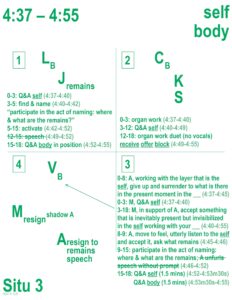
KN: It’s fascinating how you blend structure with fluidity in your work. The use of scores and diagrams, as you mentioned in Remains Persist (an evolving project that began in 2021, first presented at Performance Space New York, that explores how life experiences, particularly traumatic ones, are stored in our bodies, often repeatedly resurfacing in response to the structural conditions we live in), suggests a deep connection between choreography and cognition. Can you talk more about the role of visual scores in your practice and how they communicate something more than just instruction?

ME: The scores I create, like the one in Remains Persist, are more than just functional – they’re part of the artwork itself. I see them as diagrams, almost like visual scores that allow performers and audience members to understand the structure of what they’re engaging with while offering room for open interpretation and mystery. Speculation is key! The structure is both tangible and flexible, and it gives participants the space to connect with the work in a more active way. So, these scores become part of the collective experience, guiding while also leaving plenty of room for individual interpretation. It’s a balance between planning and allowing the work to evolve in the moment.
DA: There’s a sense of anticipation you can cultivate with these scores, especially when you mentioned the possibility of sharing them online before the session begins. How do you think this idea might impact the relationship between the audience and the performance?
ME: I think it could shift the dynamic from being purely passive to being more participatory – even if just in the act of imagining a performance practice, whether someone shows up to in fact do it or not. If we gave people access to a preview of the score or a small prompt, it’s not about over-preparing them, but rather activating their imagination. It creates a sense of connection before the experience even begins. They’re entering into it with a sense of direction, but also with curiosity, not knowing exactly how it will unfold. That’s important for me, as it mirrors how we approach movement – it’s not fixed, it’s always evolving and being figured out live through enactment and relationality of any instance.
KN: Your exploration of ‘consciousness studies’ in relation to movement is fascinating, particularly the techniques you’ve developed like ‘Glove Shed Crawl’ or ‘Directionality’. How do these practices connect to your larger idea of shifting perceptions, and how do you see them contributing to the experience of the body within art-making?
ME: The scores I’ve developed are more than just physical exercises – they’re designed to alter perception, to create new states of awareness within bodies. Take the ‘Glove Shed crawl’, for example, which plays with the idea of shedding or putting on the body or consciousness – or the idea of ‘directionality’ in which you’re expanding inward and outward, exploring the body and consciousness as both a contained space and a vast one. These exercises are about creating a space where perception and physicality blend, where you can’t quite tell where the body ends and the consciousness begins. I think this directly ties into how we relate to others. If you can shift your own perception of your body, you can create a new space for how you engage with others – more attuned, more aware, less limited by habitual ways of thinking and moving.
DA: Returning to the idea of radical togetherness, your work seems to invite a kind of collective energy that transcends the boundaries between artist and audience. How do you envision the public’s participation in this kind of work without it feeling contrived?
ME: That’s something I’m always thinking about – how to make participation feel organic rather than forced. It’s not about getting people to perform but inviting them into a shared space where they can experience the work without the pressure to ‘perform.’ I want people to feel like they can be a part of the process, whether by simply being present or by moving in response to the energy of the room. It’s about creating a space where they can reflect, breathe, and connect with the work in a way that feels real, not contrived. The work itself should be the invitation, not the need for people to prove themselves in any way. It’s about welcoming them into that generative, collective energy.
KN: Finally, Moriah, you’ve spoken about the body as a system that’s not just dependent on the self but also interconnected with everything else. How do you see this understanding of the body influencing your creative approach and your choreography?
ME: I think when we stop viewing the body as a separate entity and start understanding it as part of an infinitely divisible spectrum of existence, it changes how we move and create. The body is not just mine – it’s a part of a larger system. My understanding of my body is riddled with social projections and facades that are real but also imagined – be that gender, sexuality, race, religious affiliation, abilities. This shifts our understanding of movement, not just as a self-contained practice but as a way to connect with something much larger – whether it’s the environment, other bodies, or even the unseen energy around us. This is why I’m drawn to the idea of dance as a space for healing, for transformation. The body is an organ within a larger system, and when we acknowledge that, we create room for deeper, more holistic engagement with the world through movement.
DA: Thank you, Moriah, for sharing these insights. It’s clear that your work is not just about movement – it’s about transformation, connection, and a deeper understanding of how we relate to the world through our bodies.
ME: Thank you both. I’m grateful for the opportunity to share and reflect on these ideas with you. The body really is where it all begins, and I’m excited to see where these explorations take us.
New York–based choreographer Moriah Evans develops movement from the unseen interior of the body, activating emotional, somatic, and sensory systems to explore the sociological and philosophical hierarchies between mind and body. Her work investigates the relationship between interoception and proprioception, challenging conventional perceptions of movement and performance. Grounded in feminist, sociological, and anthropological frameworks, Evans positions choreography as a space for social and political inquiry.
London-born, New York-based, curator and writer Kathy Noble currently serves as Senior Curator at Performa, New York. There, she commissions artists to create ambitious interdisciplinary work. She has previously worked as a curator at institutions including Tate Modern and ICA London to create experimental, ground-breaking programmes. She writes art criticism and fiction and is interested in the emotional and psychological nuances of interpersonal relationships, particularly how these play out in the power dynamics of the institutions we inhabit.



