Presence Machines

So the most essential
question any theatre scene
should constantly ask is:
Why this, here and now?
Vaidas Jauniškis
Defne Ayas: What have been the most significant changes in the Lithuanian performing arts scene, in your view, which is clearly different from the art world we operate in? Thanks to the Baltic Triennial, we once worked with a minimised vessel – the actor as avatar, the body as empty stage in lieu of the white cube. What are your impressions of how the scene has evolved more broadly since 2012?
Vaidas Jauniškis: I can’t say I have one foot fully in the visual arts field, but I’ve followed it somewhat. In Lithuania, the visual arts and performing arts feel like two separate planets, each flying in its own direction. There’s very little overlap. The visual arts tend to develop more quickly, with more sophisticated and politically engaged concepts, whereas the performing arts evolve much more slowly.
When I speak of performing arts, I mean theatre, opera, experimental theatre – the whole spectrum. But I’m specifically referring to work made by people from within the performing arts field, not crossovers from visual arts. It’s a different mindset. For example, in the late 1980s and early 1990s, some composers were creating performances that were quite interesting, but they remained confined within very small, insular circles – important circles, but still quite narrow. If we want to talk seriously about socially or politically engaged work in the performing arts, it’s more relevant to focus on drama theatre and performance art, not opera, generally speaking. Opera, with a few exceptions, still operates within the framework of nineteenth-century Romanticism.
One notable exception is Sun & Sea (Marina) by Rugilė Barzdžiukaitė, Vaiva Grainytė and Lina Lapelytė, who received the Golden Lion in Venice. That was a proud moment for us, because they created something entirely different, something their academic training hadn’t prepared them for. They merged the artificial, highly structured world of opera with the unpredictability and immediacy of performance art: chance operations, coincidences, real-time presence.
When they graduated from the Lithuanian Academy of Music and Theatre, there were no performance art courses, no exposure to Brechtian language, no tradition of happenings or conceptual actions. Theatre education was – and mostly is – rooted in the Stanislavski system. And there was no real tradition of addressing social issues in theatre. So what they did with Sun & Sea (Marina) was quite radical in that respect.
DA: So there is a before and after this opera in your point of view. Please tell me some more about Lithuanian theatre.

Ivo Dimchev, Som Faves, 2009 (performance still). Image courtesy Rasa Juškevičiūtė and CAC
VJ: As for Lithuanian theatre’s relationship with social reality, I have to turn to history. During the Soviet regime, theatre invented a way of speaking about reality in metaphor – a coded language that allowed artists to communicate under censorship. That’s where its cultural importance and public respect originate. Of course, not all theatre of that time was resistant, because you couldn’t survive if you were openly defiant. But some directors managed to say important things indirectly, and that tradition is still visible today.
At the same time, during the Soviet era, theatre was also a proper medium for propaganda. That’s why artists often viewed political theatre with irony. They understood it was propaganda – and that it had nothing to do with real political discourse. Since you couldn’t speak freely about politics, artists used irony, metaphor, and hidden forms to say what couldn’t be said directly.
After Lithuania declared independence, artists were still navigating a postcolonial moment. Like in many post-Soviet and postcolonial countries, there was a collective attempt to restore a national grand narrative and reclaim supressed memory. But even then, artists didn’t quite know how to speak openly about politics. Politics was seen as a dirty game, something not worth engaging with. That was the realm of the corrupt, the powerful – let them deal with it. Artists kepts their distance, perhaps for self-preservation, perhaps out of mistrust.
That’s why we can really only begin to trace the emergence of socially or politically engaged theatre in Lithuania from around the early 2000s – say 2007, 2009, 2010. From then on, the performing arts field began to move closer to political realities and social issues. Now, for example, we see a lot of work dealing with feminism and with women’s roles in art and society, especially from young female directors. There’s a real surge of women in theatre who are addressing how to challenge patriarchal systems. We can now follow topics like the climate crisis or LGBTQ+ rights, – things that were unimaginable twenty years ago. And it’s usually the younger generation creating this work.
DA: Has Lithuanian theatre reflected these transformations? Has there been a shift in how political or social themes are approached?
VJ: These younger artists, those born after independence, or just before, are much more in tune with democratic ideals and global discourse. They’ve learned from sources outside the Soviet legacy, outside the older generation of teachers still working in the Academy.
But landscape changes: some of those older generation directors, key figures, already passed away. They were responsible for developing the important metaphorical style of Lithuanian theatre, which gained strong recognition abroad in the 1990s and early 2000s. They were part of that generation that used metaphor as a political tool under censorship.
DA: What about international recognition…?

Sun & Sea, opera-performance by Rugilė Barzdžiukaitė, Vaiva Grainytė, Lina Lapelytė at the Teatro Argentina 2021, Rome. Photo: Neon Realism © Image courtesy of the artists
VJ: I would say Lithuania’s metaphorical theatre was especially well received in the 1990s and between 2000 and 2010 in Poland, Italy, the Scandinavian countries, Russia, and France. In Germany, interestingly, it didn’t gain as much traction.
As for whether this metaphorical style was uniquely Lithuanian or shared with other post-Soviet countries, I should say that metaphorical language is a common way of speaking in all countries that have experienced dictatorship. But the Lithuanian metaphorical style was particularly warmly received and recognised in Poland. Poland was definitely a key point of connection – especially through a couple of major festivals. Lithuanian theatre was well represented at these events, and from that exposure, many productions found opportunities to travel further abroad, branching out into different countries. Although this is of course speculative, there may be a deeper cultural affinity between Lithuania, Poland, and even Italy. They’re all Catholic countries, and visuality and indirect language – various codes – are important for Catholicism. Still, Lithuania developed its own distinct vocabulary, especially when you consider how small the country is.
DA: When I was in Korea, I noticed something similar. In the 1980s, the political resistance movements there had strong support from the Catholic Church, much like the role the Polish Church played in resisting Soviet repression. The connotations of Catholicism in those contexts are so different from how we might view it today in places like the US. In Korea and Poland, it was more aligned with liberation theologies than with conservatism.
VJ: That Catholic influence does play a role, I believe. In Lithuania during the Soviet regime, we had a saying: ‘Theatre was like a church’. With churches suppressed, many people who were afraid to attend religious services turned to the theatre as a kind of ‘sacred space’– a refuge, a place for contemplation and collective experience. That common ground might explain certain aesthetic parallels, particularly in terms of visual language. Not necessarily in themes of social justice, but rather in the formal approach, the symbolism, the theatricality, the layers.
DA: I’ve been thinking a lot about how, in Germany right now, with the intense censorship and backlash in the visual arts around Palestine, there’s likely to be a resurgence in theatre. Theatre has always had this sacred role, but I think it’s going to gain new urgency, especially for politically or socially engaged work. The visual arts scene feels paralysed, and theatre might once again become a space for more participatory, investigative, truth-telling practices. At the end of the day, I think theatre is a kind of journalism, just using different methods and styles.
VJ: But I wouldn’t describe Lithuanian theatre that way – not yet. It doesn’t really operate as journalism. It doesn’t aim to investigate or interrogate. In Lithuania, it’s still more about slogans than investigations. There’s an inherited tradition from our metaphorical theatre era, where true art was expected to be poetic, indirect, symbolic. That legacy is still very much alive. Personally, I sometimes find myself missing that journalistic impulse – the directness, the willingness to investigate, to speak plainly, to engage the audience in open conversation.
That said, things are changing. The audience has changed. Especially younger audiences – they’re eager for a new kind of theatre. They’re responding with enthusiasm to participatory and socially networked forms. There’s a noticeable shift. The younger generation wants to engage, not just observe.
Since around 2010, we’ve seen a growing wave of younger artists entering the field. Many of the most compelling performances today are made by them. They bring a lot of energy and are engaged with social issues. They’re actively searching for ways to address these problems through their work. There’s also been a noticeable change in tempo and tone.
These artists are not only reflecting current social realities, but also rethinking how we deal with identity and memory – from their own perspectives. They’re asking: How do we relate to our past, to our post-colonial and colonial heritage now?
This shift is especially evident in the field of contemporary dance, which has changed substantially. In the 1990s, we had only two or three dance companies. Now we have maybe around 20. What’s particularly interesting is how dancers have moved from abstract, art-oriented, conceptual dance toward work that is social, openly speaking, even literally speaking dance. They tend to be more socially and politically engaged than theatre artists.
DA: And aesthetically, has there been a shift? Would you say it’s moving more toward post-Internet or club culture influences? Or is it still rooted in older forms?
VJ: It really depends. Some performances absolutely draw from club culture and digital aesthetics, screen and livestream are a must. Others remain more esoteric or mysterious. There’s no single dominant style anymore; it’s diverse.
I teach theatre to both Lithuanian and international students at the Lithuanian Academy of Music and Theatre. After they’ve been in Lithuania for about six months and have seen some performances, I ask them: What is Lithuanian theatre to you?
In the past, the most common responses were things like: ‘It’s dark’, or ‘There’s a lot of screaming’. That was how many people experienced it – intense, expressive, often quite heavy. That tendency toward shouting, I think, was influenced by Russian theatre, especially its very expressionistic style. Now, though, that tradition is starting to fade. Theatre here is becoming lighter, more varied, and more accessible in tone.
DA: Does theatre still function as a space for public discourse in Lithuania?
VJ: Theatre is currently trendy or in vogue, but that doesn’t necessarily mean it’s creating public discourse in a meaningful or provocative way. Only a handful of productions really manage to stir public debate or touch on something emotionally resonant that enters broader conversations. For most people, going to the theatre is just part of a cultural routine – like going to a concert today, a theatre performance tomorrow. I wouldn’t say it’s generating particularly provocative or challenging discussions at the moment. It now feels a bit too cosy, too safe within the current cultural landscape.
As for the audience, it has definitely changed. I’d say this shift strongly correlates with the rise of the middle class and especially the emergence of hipster culture. We’re seeing much younger audiences now. They’re curious and eager to experience something new, not just something polished.
DA: What role do festivals now play in shaping discourse, taste, or artistic direction in Lithuania? I’m thinking, for instance, of Turkey: festivals there became part of a broader neoliberal scheme in the 1990s. Even though Turkey wasn’t Soviet, the structure felt very similar. With the mushrooming of festivals, it often felt like dissent was being sanitised through cultural platforms.
VJ: Yes, I’d say festivals played a very significant role in Lithuania in the 1990s and beyond – they introduced new ways of thinking about theatre. They offered alternative theatrical languages and approaches, showing how theatre could speak to people in different ways. In that sense, they served an educational – perhaps even compensatory – function, by presenting things that audiences would never encounter during the regular season. LIFE, and later the Sirenos festivals, presented really perfect examples of postdramatic theatre. The New Baltic Dance Festival became especially important; it’s now one of the strongest contemporary dance festivals in the Baltic region. It presents very high-quality work and has helped develop an entire field.

DA: The daily fear and anxiety people feel here – I sensed it when I came for research a few months ago. The presence of war so close by, the German troops now stationed here, there’s a real militarisation programme underway. It’s a lived reality. And I suppose that’s also feeding directly into the theatre scene, as you were just describing.
VJ: Politics is very present in the air right now. There’s a strong sense of solidarity with Ukrainian artists, for example in the work of Agnietė Lisičkinaitė. Several Ukrainian plays have been presented in Lithuania, and works by Ukrainian authors – especially contemporary literature from Ukraine – are becoming more visible. Some Lithuanian directors are actively seeking out Ukrainian writers and collaborators, with some even staging performances in Ukraine. This kind of cultural solidarity is very tangible on stage.
DA: What excites you the most about the current cultural landscape? And how does that relate to your experience sustaining independent platforms like Menų faktūra?
VJ: What really excites me right now in the Lithuanian scene is that the next generation is stepping up. I’m waiting for something new. I hope to see more radical, more interesting steps in the arts – both in artistic expression and in political and socially engaged practices. I’ve seen many strong examples of this kind of theatre abroad, and I still hope that this way of thinking – theatre that actively seeks change – is possible in Lithuania.
DA: What, in your opinion, is the most urgent question that Lithuanian theatre – or perhaps theatre more broadly – needs to ask itself today?
VJ: Theatre is always about the here and now. So the most essential question any theatre scene should constantly ask is: Why this, here and now? That’s the core of it – Why are we presenting this piece, in this place, at this moment? How can we communicate and why? If a work can’t answer that, then it’s lost its purpose. It might sound boring, but I always ask: Why now?
DA: Back to the visual arts, do you think Mindaugas played a significant role in shaping the Lithuanian scene as it stands today?

Agnietė Lisičkinaitė, Hands up, 2023. FiraTarrega, Spain. Photo: Marco Pavone
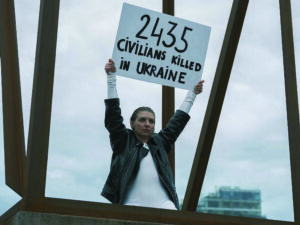
Agnietė Lisičkinaitė’s artistic action for Ukraine, It is not only numbers, 2022. Vilnius, Lithuania. Photo: Martynas Norvaišas
VJ: I remember spending evenings at the Contemporary Art Centre – lots of beer and long talks in the caf. downstairs. Often, those caf.s were more populated than the actual exhibition spaces. [laughs] But the Mindaugas Triennial was a great opportunity to see artists like Miet Warlop with her strange creatures. And Ivo Dimchev’s Some Faves is one of my favourite performance art pieces – I can still remember his sweat-soaked shirts and bleeding eyebrow. But again, very few of these events really influenced the theatre field. It was just a different tempo, different ideas. In theatre at that time, we were only just beginning to experience what we now call the ‘performative turn’.
DA: What about Raimundas Malašauskas’s edition? How would you assess its impact, especially compared to Mindaugas? We were able to build on his triennial. Did that resonate more with the local scene?
VJ: At that time, there was a kind of temporal disconnect. Theatre was still catching up.
DA: And how would you describe the influence of the Lithuanian Pavilion in Venice? For a while now, it has had a distinctly performative quality.
VJ: That Pavilion with Sun and Sea (Marina) winning the Golden Lion had a huge impact, especially on how the political sphere began to view culture. It sent a message that Lithuania can excel not just in sports – like basketball – but also in culture. The fact that the piece was created by three young women and went on to win the Golden Lion shifted perceptions. And the way it was done – blending theatre and performance art – really opened up new possibilities. It didn’t just impact creators; it reached audiences. It showed that theatre can take radically different forms. Because of Sun & Sea’s success, performance art is no longer dismissed as marginal or ‘nonsense’ art. It’s now seen as something that can make a real impact – even something worth investing in. The Golden Lion gave it weight. Even for politicians, performance art became not just ‘weird’ anymore – it became something the state could take pride in.
DA: You know that I was on that jury!
VJ: Ah, perfect then – you know exactly how much it mattered.
Vaidas Jauniškis is a theatre critic, columnist, and lecturer at the Lithuanian Academy of Music and Theatre in Vilnius. He writes widely on performing arts and cultural policy in Lithuania and internationally, and is currently pursuing a PhD focused on political theatre in Lithuania. From 2005 to 2017, he worked as a project manager at the Arts Printing House and was the editor of www.menufaktura.lt, a leading website on performing arts. He has served as a member of the Lithuanian Council for Culture during the terms 2013–2017 and 2021–2025.



