The Sun is God. On the Naturalism of M.K. Čiurlionis

Much of the critical discourse around the paintings of M.K. Čiurlionis revolves – outside Lithuania, at least – around whether he should be recognised as the ‘first’ abstract painter, an accolade for which he is often placed into competition with Wassily Kandinsky and Hilma af Klimt. Much of this discussion has historically turned on when exactly a painting crosses the boundary separating representation from abstraction so that arguments can be made for earlier artists – Monet, Whistler, Turner – having made the decisive step.
The debate over when painting achieved abstraction is reminiscent of the Bald Man paradox: losing a single hair can never be said to make a man bald, so how can you say at which point he crosses the line into baldness? How blurred must Monet’s waterlilies be before we can call them abstractions; how obviously must Turner’s sunsets be merely pretexts for experiments in colour and form before their source becomes irrelevant? Čiurlionis’ paintings suggest that these are the wrong questions.
To call a man ‘bald’ or a painting ‘abstract’ are convenient categories that we use to compartmentalise, identify, and thereby order our impressions. Čiurlionis does not so much complicate as disregard entirely these semantic distinctions. The late Winter cycle (1908) might be the most widely discussed of his work because it can be taken to describe a conventional shift from figuration towards abstraction. Recognisable organic and artificial forms (trees, candelabra) break over the course of its eight constituent parts into patterns and shapes that cannot easily be traced back to the observable world.
And yet this is more than the crossing of some art historical Rubicon, because Čiurlionis’ play between figuration and abstraction is only symptomatic of a much grander confusion of categories: between life and death, matter and spirit, self and world, human and divine. In Serenity (1904/05), a rocky island is invested with a malevolent spirit that reverberates through the sky and sea; The City (1908) more closely resembles a revelation of heaven than an architectural study. Rather than identify a boundary between an objectively real world and a Platonic realm of pure forms, these works endorse Paul .luard’s proposal that ‘there is another world, and it is in this one.’.
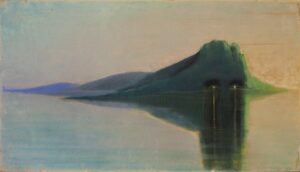
M. K. Čiurlionis, Serenity , 1903–1904, pastel on paper
The problem is not that we use names to distinguish between things – that we make what Karen Barad, in Meeting the Universe Halfway (2007), calls ‘cuts’ in an interconnected world in order to navigate it – but that we mistake these names for an objective truth. Looking through my window, I see a tree. But this tree cannot practically be separated from the soil through which it traffics minerals, the mycelial network to which it is connected, the sun from which it metabolises nutrients, and so on. But it is more conducive to my finishing this essay if I label it a ‘tree’ and stop dwelling on the pattern of its weave into the fabric of the universe.
So it might be argued that the paintings of Čiurlionis, which figure a world indivisibly connected and overwhelmingly alive, work against the tendency to ‘abstract’ or isolate any element from the phenomenal world of which it is part. The greatness of his achievements consists not in having been first to ‘move beyond’ the sensible world into a transcendent realm but in perceiving the latter in the former and reconciling them in his paintings.
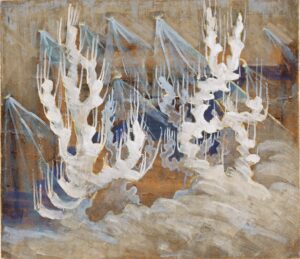
M. K. Čiurlionis, Winter cycle (2 out of 8, 1907). Tempera on paper
I get no sense, to take for an example the extraordinary Winter cycle, of colour and form being ‘abstracted’ from the landscape in the sense of pulled out or removed from. Rather they are properties integral to the natural world, a repository of effects that can be arranged into patterns without the need violently to separate them from the contexts that produce and make sense of them. No property of these worlds can be understood independently, any more than the writer of this text cannot be abstracted from the air on which he is helplessly dependent for oxygen, any more than a fish can be abstracted from water and survive.
Indeed the very determination to anoint Čiurlionis as the first to do anything – whether pioneering abstraction in painting or the twelvetone method in music – misrepresents the character of his genius. To presume that novelty is consistent with value is to align creativity with the ideology of progress. But Čiurlionis’s most powerful works construct a bridge to the past at least as much as they make a leap into the future, unsettling a twentieth-century art history founded on the myth of modernism’s ‘clean break’ from that which went before.

M. K. Čiurlionis, Winter cycle (4 out of 8, 1907). Tempera on paper
Like another polymath with whom he can be usefully compared, William Blake, Čiurlionis’ paintings evince his ability to perceive ‘a world in a grain of sand / and heaven in a wild flower.’ The artist does not have to bypass or move beyond the world of appearances in order to access the divine but rather pay it the requisite attention. The work of these two visionaries shares an extraordinarily powerful alertness not only to the way that all material and consciousness are connected but also to the presence of the whole in the part, and the illusion of all absolute divisions, death included: ‘hold infinity in the palm of your hand / And eternity in an hour.’
Ben Eastham is a writer and editor based in Rome. He is editor-in-chief of e-flux Criticism and co-founder of The White Review. His second book, The Imaginary Museum, was published in 2020. He is the editor of books on artists Fabio Mauri (2019), Luis Camnitzer (2020), and Arshile Gorky (forthcoming, 2025). He was the publications editor and a co-curator of the 14th Shanghai Biennale and is the publications editor of the 2025 Seoul Mediacity Biennale. His writing on art and literature has appeared in The New York Times, London Review of Books and other major publications. He has also written monographic essays for artists, including Ed Ruscha, Camille Henrot, Kati Heck and Monir Shahroudy Farmanfarmaian. Previously, he was an editor at ArtReview and an associate editor at documenta 14. He is currently working on a new book to be published by Fitzcarraldo Editions.



