Vilius Orvidas: The Stone Altars


Orvidai Homestead, 1992. Photo: Leonardas Surgaila

Orvidai Homestead, 1992. Photo: Leonardas Surgaila
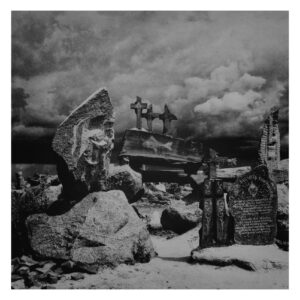 Orvidai Homestead, c. 1990 (Vilius was still alive). Photo: Modestas Ežerskis
Sanctuary of Boulders
Vilius Orvidas (1952–1992) was a third-generation stone-carver. Upon completing his military service in the soviet1 army in 1973, he returned to his parents’ homestead near Salantai and started shaping it into a sculpture garden – a project he continued until his passing in August 1992. It all started with attempts to rescue massive boulders from soviet land reclamation projects. At the time, boulders would typically be brought from fields to the quarry and broken apart, and lone homesteads would be demolished, with the old trees around them chopped down. Vilius would bring these field boulders and ancient oak trunks back home, piling them up, as he tried to preserve some of the antiques, all the while digging ponds and planting trees on his land. Gradually, the homestead became a sanctuary of sorts, attracting a broad spectrum of visitors – tourists, artists, nomads, addicts, and prisoners with nowhere to go after serving their sentences. These people were akin to boulders in need of saving or desert plants worn down by the wind. Vilius welcomed them all, offering food and shelter. For some, he proved instrumental in transforming their lives.
The homestead dwellers were subject to a simple routine: an honest day’s work, a modest meal, and an evening rosary. Nevertheless, some evenings gave way to conversation, discussion and merriment. Vilius himself was constantly at work; people recall him chiselling ceaselessly. Curiously, among the plethora of aspects of Vilius Orvidas’s life that are typically discussed, his sculptures receive relatively little attention. In the spring of 1992, with Lithuania newly independent, Vilius took the opportunity to exhibit five of his sculptures at the Contemporary Art Centre in Vilnius – yet, they were ‘hardly noticed by the critics’.2 The Orvidai homestead stood for faith, acceptance, openness, humility in the face of God, and refusal to give in to the crushing system. The sculptures were just one part of this greater whole. The sculpture garden was built intuitively, with spiritual alignment taking priority over aesthetic direction. This may be one of the reasons why Vilius (‘by the way, I do not consider myself a sculptor’3) and his contemporaries4 attached little importance to individual sculptures. It is the aggregate that gains significance, encompassing all the different aspects of Vilius’s spiritual quest. He did not choose a straight path of Christian faith, but took an interest in a variety of spiritual practices. The sculpture garden integrates Buddhism, yoga, and esotericism as much as Vilius’s personality did, becoming an odd yet harmonious formation.
In a sense, the processes unfolding at the Orvidai homestead during the late soviet era were tantamount to phenomena that entered the Lithuanian art scene much later as contemporary art practices. Life at the Orvidai homestead could be compared to the subsequent socially engaged creative practices that prioritise community over the resulting piece of art, co-creation, and having a social, political, or economic impact. The stone sculptures at the homestead were made by Vilius, while the wooden ones were carved by Modžius (Modestas Grigaliūnas) and others. When he later remarked, ‘nothing here is mine’, it was more than artistic posturing. In one way or another, everyone who stayed at the homestead contributed to its playful co-creation. ‘Vilius would also let others add signs and marks on the stones and sculptures he had carved.’5 Some admonished him for this, seeing the touch of another as ‘polluting’ the authorship – something the modernist approach would typically assign to a single individual.


Orvidai Homestead, 1992. Photo: Leonardas Surgaila
The shape the homestead took since Vilius’s untimely demise was not intended to be final. Vilius saw it as something alive, growing and changing. There should have been a clay housing complex – Vilius cared about ecology: ‘[…] our Earth is heading for a catastrophe now that we have polluted the water and air. We have used it all up’ (1992).6 He was unsettled by Lithuania’s sudden and open embrace of vicious capitalism. He felt the darkness approaching: ‘Now, as one can feel, is that time of the devil, now he wishes to make us his servants’ (1990).7
Barefoot Purity
Among the many recollections recorded in the edited volume Kitoks Vilius Orvidas [A Different Vilius Orvidas] (ed. D. Parulskienė, 2003), one struck me deeply: two girls from Vilnius head out to the Orvidai homestead for the summer. Vilius greets them barefoot, his hair possibly drenched with sweat and stuck to his forehead – the way we see him in photographs of that time. One of the girls (her name is not mentioned in the book) is irked by the filth. Yet, upon her return to the city, she realises it was she, not the homestead, who was unclean. Naturally, the talk here is not of the dust of the open road, trapped under the soles of her sandals, but of ontological cleanliness and purity. Such cleanliness can be phenomenologically interpreted as a profound existential state of being, drawing, for instance, on Martin Heidegger’s concepts of existential phenomenology. States of increasing clarity and enshrined authenticity of being are achieved by cleansing oneself of that which is inauthentic. The notion of cleanliness is significant in phenomenology, mysticism, and many of the world’s religions. The body is cleansed through special rituals, while practices cleanse the mind. A Buddhist teaching suggests that you empty your glass before asking me to pour you some water. Among the oft-cited teachings of Meister Eckhart – the medieval mystic – is the notion that one must become pure, i.e., ‘pure nothingness’, as only a pure soul can accept God. Vilius wilfully pursued purification in a Christian manner: ‘When your thoughts are pure, no one can get at you. Though they do try – at night in your dreams or in other ways. The moment you leave a thought uncleansed, they start to “hit” you immediately – with a force equal to the darkness you’ve allowed to rise within.’8 The notes that Vilius made in his journals suggest that he contemplated the balance of power of light and darkness in a human heart, akin to renowned Christian mystics. For instance, Simone Weil – a French philosopher and mystic – wrote: ‘Purity is the ability to contemplate defilement. Radical purity can contemplate both the pure and the impure.’9 It is not clear whether Vilius was familiar with Weil’s philosophy, but he followed the same direction. A woman visiting the homestead back in his day recalls: ‘[…] Once, after a rain I kept wiping my dirty feet before the entrance, I said I should wash them, and Vilius said “Your feet do not matter, your soul is beautiful.”’10
Vilius was so pure (open and clear) that he could be many things and accept all kinds of people without judgement.
[Vilius] was a child
He was grass
He was a bird
He was a pagan,
He was a yogi,
[…]
He was a Buddhist,
[…]
He was a follower of Krishna,
[…]
He was a Catholic,
He was a shelter
[…]
He was a Franciscan monk.
— Sigitas Benas Jurčys OFM 11,12
Yet, it was precisely the pure ones whom the soviet regime considered threatening. Thus, the notion of cleanliness should be discussed differently in the context of soviet realities. Everything was mixed up in that world, seemingly made by the devil himself. The purest ones had to be made dirty – and that system had a way of going about it. For instance, a young man applying to the seminary would be called out by an officer to make a deal: he would only be admitted if he agreed to inform on the persons of interest to the KGB. A young man applying repeatedly for a few years would be deemed acceptable. Yet, someone admitted upon the first attempt could be stained by a deal with the violent regime.
Paradoxically, the balance of light and darkness constitutes the phenomenon of that place: it was only in response to the system of soviet coercion that the homestead became a safe haven for those willing to resist and stay true to themselves. According to Leonid Bazhanov – a Russian art historian and a family friend to Orvidai – ‘should something happen and I’d need to hide, I’d make it out here, no one would find me or betray me.’13 In a living testament to Weil’s philosophy, which stated that evil is proof of God’s existence, Vilius said, ‘Andropov’s death [in 1984, O. J.] marked the start of targeted attacks against the homestead. They started as soon as we had it consecrated.’14
Purity is one of the features of outsider art. Known as art brut in French, these are works by self-taught artists made outside the margins of the official culture. It has also been suggested to call these types of works artless15 – simple, natural, without trickery, artifice or pretence. In the context of outsider art, purity means authenticity derived from [almost radical] honesty.16 Outsider artists disregard tradition, canon, or the opinions of others. Their creativity arises from an internal impetus, bursting out pure and unprocessed. If the depths of an artistic self tremble with anxiety, longing, weird ideas or a feeling of being stuck, their work will reflect that, with slight variations in form. Faith and spiritual openness constituted the core of Vilius Orvidas. His creativity gave material expression to faith – one which continues to surprise and provide food for thought. Nothing like it existed in Lithuania at the time. Vilius proceeded with his creative pursuits, breaking with conventions and persevering despite the lack of family support and understanding in his environment, as well as governmental pressure.

Orvidai Homestead, 1990s. Photo: Audrius Naujokaitis


Pilgrimage from Vilnius to Žemaičių Kalvarija, 17 June – 1 July 1989. Photo: Sigitas Baltramaitis
Stone Pilgrimage
Vilius was inevitably affected by the patriotic uproar and the national spirit rising with Sąjūdis.17 The summer of 1989 was special. In June, Vilius took part in a Lithuanian pilgrimage. The pilgrims took turns carrying a cross from Vilnius to Žemaičių Kalvarija – a journey of over 300 kilometres. When they’d stop to rest, the locals would greet them and bring them food. In August that year, Vilius took monastic vows, taking the name Gabrielius. His ordination took place at the Orvidai homestead, with Mass held at a stone altar he had crafted, amidst the massive boulders, ancient oaks with their roots set to face skywards, and the sculptures made by Vilius and other artists. A few years ago, this same sculpture garden was referred to in the press and in common parlance as the museum of nonsense and absurdities.18
The following week, Vilius gave three stones to four young Franciscan monks. They took them to Nida, a pristine corner of Lithuania. On 22 August, they set the stones to form an altar on Parnidis dune. Many people gathered, and a mass was held. Following Vilius’s instruction, after the mass, the monks were to divide up the stones and drag them across the dunes as far as they could. They were to leave the stones where they’d stop; that would be God’s chosen place for them. The supporters, who were to provide water for the monks, abandoned them for another event – on 23 August, people from the three Baltic states joined hands, forming a living Baltic Way between the three capitals – Vilnius, Riga, and Tallinn. The young monks, left alone in the sandscape, dragged these parts of the altar across for three days, covering a total of 1.6 km, and, upon tiring, left the stones to lie there. Over time, the stones were entirely covered up by sand, and not a trace remained. A few decades later, during the making of a documentary, Nešėm, kol pavargom [We Carried It Until We Grew Tired] (2021, directed by Vytautas Gradeckas), two of the three altar parts were found and unearthed. They were discovered 800 metres away from the Russian border – the place is presently inaccessible to worshippers.
I once took an unusual route to Salantai, and a tree caught my attention. Its top reached much higher than those of the other trees nearby. As I focused on that strange tree, standing out in the typical landscape, it occurred to me that I was approaching the Orvidai homestead. And sure enough, a moment later, I saw the road sign pointing to it. I recalled the teachings of Don Juan taken down by Castaneda – to scan the environment with an unfocused gaze in order to notice the slight flickers – that’s where the ‘other worlds’ open up.19 Castaneda’s works have been reclassified from anthropology to fiction; yet, upon reading them in my youth, I developed a habit of observing my surroundings, taking note of the details.
This tree that suddenly invaded my field of vision reminded me of the insights shared by Massimiliano Gioni, the curator of the 55th Venice Biennale in 2013: he had constructed the narrative of the exhibition based on ‘insider’, as well as outsider art, and reflected that art is prone to dismantle categories, rather than entrenching them, with works of self-taught artists being particularly illustrative in this sense. This, he argued, is the only way to expand the boundaries of art as a domain.20 Artists who come to disrupt and/or dismantle the established categories and canons stand out in their environment like that tree against the landscape of Salantai. Vilius stood out in the Lithuanian cultural milieu. He was different and misunderstood.
Stone-carvers know that stones do not sink into the depths of the earth – to the contrary, the earth pushes them upwards. In a manner similar to stone or parts of that altar, the legacy of Vilius Orvidas, as well as memories and events related to him, are continuously unearthed from the sands of time. Though many eyewitnesses attest to the fact that ‘the place is not what it used to be’, it is alive in the works of poets, writers, and directors, in curatorial projects, and discussions. It is symbolic that the sands have thus far returned only two of the three altar stones. We must wait for the third to resurface.


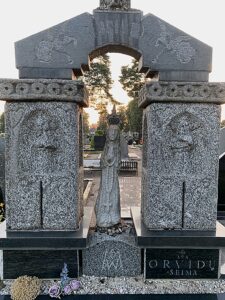


Top four images: the grave of Vilius and his parents. Bottom image: the grave of Vilius’s grandparents. Photo: Oksana Judakova
I was surprised by the Orvidai family gravesite in Gargždelė cemetery. Vilius’ grandparents are buried in a separate plot, marked with a solid tombstone. In keeping with the aesthetics of the time, the font is Roman and a relief of Our Lady modelled on a plaster cast of Michelangelo’s Pitti Tondo (which can still be found at the homestead). The lines are clean, and the surfaces are polished. A small crucifix can only be seen at the very top – closer to an old, time-worn wooden figurine than a durable stone sculpture. Vilius’ style is recognisable.
The stone marking the graves of Vilius, his parents, and his brothers is different altogether. Its composition is akin to a wooden Samogitian chapel, with a tiny figure of Our Lady inside, it is at once massive and complex. Each of its three sections employs a different style, stone, and chisel. The crucifix on top has the body of Christ convulsively twisting away from the cross – the same coarse chiselling with melting lines. On the reverse of the cross are Chinese characters for ‘rest in peace’: a highly unusual sight in an old provincial cemetery in Lithuania. These gravestones attest to his mastery of craft, as well as his freedom to play with and disregard the ‘canon’. Vilius is considered the author of both gravestones, though others may have contributed.
Oksana Judakova is a graphic artist, designer, curator, and a member of the Lithuanian Artists’ Association. She studied graphic design at Vilnius Academy of Arts and holds a master’s degree in Art Curatorship from Vytautas Magnus University, where she is currently a doctoral student in Art History. From 2003 to 2012, she lived and worked in New York. On her return to Lithuania, she and her husband founded the gallery, Vilkamirgės, in Ukmergė, where she has been curator since 2017. Her texts have appeared in numerous Lithuanian cultural publications.

1. In this translation, ‘soviet’ is written in lowercase. This is a deliberate stylistic choice to reflect a critical perspective on the regime, treating it as a concept rather than a formal proper name.
2. Vaidotas Žukas, Vilius Orvidas (Vilnius: Baltos Lankos, 1999), p 59.
3. Daina Parulskienė, Kitoks Vilius [A Different Vilius Orvidas] Orvidas (Vilnius: Versus Aureus, 2003), p 219.
4. Except, perhaps, for Vaidotas Žukas, who considered Vilius’ sculptures truly precious.
5. Vaidotas Žukas, Vilius Orvidas (Vilnius: Baltos Lankos, 1999), p 41.
6. Daina Parulskienė, Kitoks Vilius Orvidas [A Different Vilius Orvidas] (Vilnius: Versus Aureus,
2003), p 222.
7. Ibid., p 11.
8. Ibid., pp 11–12.
9. Simone Weil, Sunkis ir malonė [Gravity and Grace], trans. Arvydas Šliogeris (Vilnius: Katalikų
pasaulio leidiniai, 2015), p 124.
10. Daina Parulskienė, Kitoks Vilius Orvidas (Vilnius: Versus Aureus, 2003), p 183.
11. Latin for Ordo Fratrum Minorum
12. S. B. Jurčys, OFM, reads this litany in the film Akmenorius [Stone Carver], directed by Maciulevičius (Vilnius: Kastalija, 1994), 28:12.
13. Vytautas V. Landsbergis, Vilius Orvidas, documentary (Vilnius: Studio A Propos, 2001), 27:08.
14. Daina Parulskienė, Kitoks Vilius Orvidas (Vilnius: Versus Aureus, 2003), p 219.
15. The French painter Jean Dubuffet was the first to come up with a term for this – art brut (1945). The British art historian Roger Cardinal introduced the English-speaking audience to Dubuffet’s ideas in a book called Outsider art (1972) – the original working title was The Art of the Artless.
16. The French sociologist Pierre Bourdieu, being generally sceptical about the outsider art, has nevertheless proposed a concept applicable to it – that of disinterestedness of the artist: a truly authentic artist is one not motivated by the anticipation of an external reward (such as fame, finance, or authorship).
17. Sąjūdis (literally ‘The Movement’) was a political and social movement established in Lithuania in 1988. While initially formed to support democratic reforms and national revival within the soviet system, it quickly evolved into the leading force advocating for the complete restoration of Lithuania’s independence. Its activities were instrumental in leading to the declaration of the Act of the Re-Establishment of the State of Lithuania on March 11, 1990.
18. See, e.g.,‘Absurdo muziejus’ [Museum of the Absurd], Tiesa [The Truth], 30 September 1989.
19. Carlos Castaneda, Don Chuano mokymas: Jakių pažinimo kelias [The Teachings of Don Juan:A Yaqui Way of Knowledge] (1968).
20. Tansella, C. 2018. ‘In Conversation with Massimiliano Gioni.’ Epidemiology and Psychiatric Sciences 27: 543–45. https://doi.org/10.1017/S2045796018000550.



