Vocal Notes for Labouring Worlds

These slightly autofictional notes reexamine and rechew the creative power of dis/articulation and language through the tropes of various ontological mechanisms of opening and closure that articulate materials and subjects. Mouth (other similar tropes could be a vagina, anus, door, portal, etc.) here is presented as a mould for world-shaping, which was one of the most important themes of M. K. Čiurlionis’ oeuvre.
I had difficulties falling asleep when I was about five, the same year I started school and began learning the alphabet. There was this vivid pre-dream stage, a feeling of pre-understanding, a vision or something in between, in that hybrid of imaginary and real mouths. I’d call that mouth cybernetic – a mixture of flesh and the imaginary.
***
I don’t know if I had seen Čiurlionis’ paintings by then. We lived in the city which hosts his museum. Every family had an album or two but not mine. My family had nothing to do with fine arts.
***

Pakui Hardware, Eurecstasy, 2015. 3D print produced by New Scenario for ‘BODY HOLES’, 9th Berlin Biennale, 2016
Let’s try to open that childish mouth more open. Inside this cybernetic cavity space, in a mouth, a (pre)letter, a sign floated. On its own, unstoppably, as if it was alive. I was trying to connect to it, chew it, and communicate to it by shaping it into signs that I was familiar with – to articulate it. It was an electrifying experience. In return, this living, animated pre-letter was articulating, chewing, shaping, and sculpting my mouth and, through that connection – the whole me. As if I had some sort of a cybernetic pre-alphabet loopback in my mouth. It was not pleasant. It was as if something alive and robotic was floating in there, a part of me that I could only partially control. It was one of the scariest understandings of yourself you could conceive.
And the colours! That floating pre-letter or phoneme was in neon. From electric yellow to synthetic green to bright blue. This pre-language sign, the shape and colour, would change with each touch of the tongue. Planet-like neon signs levitated between cavities. That bond between the rather abstract and coloured pre-language sign in the mouth and tongue, cavities, neurons, brain, and electrons firing inside the brain – this was how I imagined it then – was mutual.
***
As Karen Barad explained intra-action in an interview, ‘the usual notion of interaction assumes that there are individual independently existing entities or agents that preexist their acting upon one another.
‘By contrast, the notion of “intra-action” queers the familiar sense of causality (where one or more causal agents precede and produce an effect), and more generally unsettles the metaphysics of individualism (the belief that there are individually constituted agents or entities, as well as times and places). According to my agential realist ontology, or rather ethico-onto-epis-temology (an entanglement of what is usually taken to be the separate considerations of ethics, ontology, and epistemology), “individuals” do not preexist as such but rather materialise in intra-action. That is, intra-action goes to the question of the making of differences, of “individuals”, rather than assuming their independent or prior existence. “Individuals” do not not exist, but are not individually determinate. Rather, “individuals” only exist within phenomena (particular materialized/materializing relations) in their ongoing iteratively intra-active reconfiguring.’1
***
To reiterate, it felt like a (pre)language-(non)human-material process of being intra-articulated into something or someone else by generating new (pre)language panoramas inside and outside of bodies.
Into intra-what exactly?
Into an endless gallery of animated neons dancing and mating in your mouth/brain-space-cavity-you. You were five years old. The whole world was yet to be articulated, understood, pronounced, just like you.

Slavs and Tatars, Mother Tongues & Father Throats , 2012, woolen yarn
Many years later, I chatted to Marcos Lutyens, an artist and hypnotist.2 According to him, there is an urgency to create a new language in these times of multiple ecological, political, and other crises. One of the ways to do it is to advance into pre-language states, among other possible methodologies. Lutyens mentioned the ultimate place of shelter being perhaps in the cavity, or ‘cave’ of your mouth, out of which a weaving of words might create an imaginary dwelling.
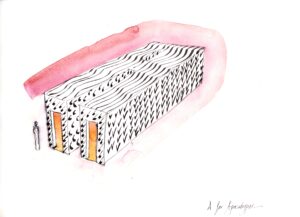
Marcos Lutyens, A for Apocalypse, drawing from a series of ‘Alphabet Huts’, 2020
According to the artist, the experience of the colour-light letters in the mouth, in the cavity, is a reflection of the interconnectedness of the brain before neural pruning separates the brain centres into their compartmented islands. Some people preserve this interconnection of sensory and cognitive overlaps into adulthood, a condition called synesthesia, from Latin, which translates to ‘union of the senses’. This is linked to Lutyens’ work with hypnosis. He uses his voice to create para-realities through language as a vector for externalising internal spaces and ideas. This practice presupposes the need to articulate the connection between how language is born and how we use language as something that is already given to us. It seems that the language we are given is not enough because it leads us to all the pre-existing problems. To move ahead more successfully, we need to analyse the connection between dreaming, imagining/researching, and world-shaping. In this sense, the alphabet and grammar should not be understood as constraining, given, or objective but rather as another anonymous and free material or system to work with and within.
***
If we consider a mouth and its cavity as a certain synesthetic space, where new words and worlds are being created, moulded, and cast, we may also expand the trope by using examples of other moulding cavities such as the vagina, womb, anus, etc. Depending on the discourse, this multifaceted space could be interpreted as the space for moulding and casting, as the space for radical openness and closure, a furnace of light, the Bing Bang, to use a biblical reference to the creation of the world – the so-called heavenly womb, where the creation of imaginary dwellings are taking space. Light is the most essential material and the most elusive part, the ‘pure information’,3 which can appear as both the big-mouthed messenger and the message itself.
It’s no accident that stories of the origin of the world often start with mentions of light, with calling upon light, with moving away from the darkness, from the void, from the past. This bright new world, this awakening world, is still not the world we know. It’s not ours as it is symbolic. It is pregnant with transformation, awakening, and becoming.
***
What exactly is the world in this furnace of the mouth? It is the world of being pre-articulated, prenatal, unconscious, and abject. One may ask: What – and where precisely – is this space? Is it the mythological reality of Genesis on the first day of creation or perhaps a month and billions of years after the Big Bang? Or is it the reality of our unconsciousness, of the dream in which we are immersed before we are re-created each morning, a second before the alarm clock rings?
Take, for example, Composition (1903), an early painting by Čiurlionis, who was also a renowned synesthete. The most straightforward and somewhat reductionist interpretation of this work would be that it represents the antagonistic world as it was characteristic to the rather symbolist Art Nouveau period: light vs darkness, a primordial chthonic hybrid creature of uncertain gender vs celestial female (?) figures, etc.

M. K. Čiurlionis, Composition, 1903, crayon on paper
On closer inspection, it becomes evident that the painting could be seen as more sophisticated than that.
Let’s start with an exceptional occurrence that the painting contains. Two rows of fairy-like cloud-women meet in the middle of the painting, holding the sun above a gap in a greenish-brown forest wall (together with the sun, they seem to form a bridge). Below the gap, we see a mythological hybrid creature that looks like Gollum from The Lord of the Rings. This figure, who is almost in a fetal or, depending on interpretation, in a defecating (the internal cavity of the rectum is another example of moulding and casting) position, seems to have its right hand stretched out in greeting.4 Notice how the surreal creature’s round blue eyes borrow the colour of the sky, how the red of their flesh seems reminiscent of the colours of dawn and sunset or fire and hot metals in a furnace. And notice how their mouth – I’m obsessed with mouths, and will mention a few more later – is open as if it is saying something. Is it a greeting? Its long red tongue is dripping with a cloudy white substance as if its mouth is watering – or perhaps it has been eating cloud-women? On closer inspection, it seems the creature is saying something with its lizard-like bright tongue and long white protruding fangs.
This part of the painting and the mythological creature define the rather celebratory mood of Composition, especially when compared to the wellknown painting Saturn Devouring His Son (1818–1823) by Francisco Goya (1746–1828). According to the classical interpretation, this painting depicts the Greek myth of Titan Cronus, who, apprehensive about a potential overthrow by his offspring, consumed each of his children upon their birth. The painting belongs to Goya’s ‘Black Paintings’ series – hence the black background and the deadly black of Saturn’s mouth.
It is clearly a painting of a radical disaster, of an end, as Saturn is literally pushing his son’s body into his black mouth, from which nothing can be born. It is an act that produces no descendants, no continuity, and can only maintain the deadly status quo. Contemporary interpretations of this painting easily suggest to us the critique of autocratic patriarchy or even fossil capitalism which would rather kill everyone’s future than accept change.
Čiurlionis’ painting is a clear antithesis of this black painting. His painting is about the daily celebratory act of greeting the sun. Greetings and openness are the most important tropes in Composition: one row of cloud-women salutes the other while together they hold the sun, and the ambiguous-looking creature greets us and invites us, as viewers, to participate in the act of creation.
***
Let’s compare Čiurlionis’ Composition with Edvard Munch’s (1863– 1944) painting The Sun (1909) – a less figurative symbolist and more graphic mural. Both paintings are symmetrically structured, with suns as their central symbolic and compositional elements. The sun and its light were essential for the painters of the period for many different reasons, including the painterly nature of the light itself (how light constantly changes colour while recreating the landscape, etc.) and its symbolism (of life-giving vitality, etc.). What is important in these paintings is that both represent unique constellations. There is a significant relationship between the sun, the rays it casts, and the landscape as some sort of mould in between.
Both paintings depict scenes of creation that can be compared variously from a sculptural point of view to a celestial furnace (given the bright light and red heat of the sun), a heavenly womb (compare their compositions to that of The Origin of the World (1866) by Gustave Courbet (1819–1877)), or a mouth that is about to talk, to announce, to transform the world into Logos, knowledge and discourse. In Composition, it is the sun, the sky and rows of surrounding cloud-women above the forest-bridge and the gap between that bridge that together function as a mould. In The Sun, it is the sun, the sea and the surrounding hills at the edges that stand for a furnace. Thus, the paintings reveal the life-giving, sculptural nature of the process of creation in general, as well as that of the creation of the world.
A process of casting and molding is present in the process of the creation of new forms, shapes and fonts if we talk about mouthly creations. The mouth trope functions as a framing site for forming, sculpting, stamping and maybe even giving birth to new materials, shapes, interpretations and constellations – and perhaps even new worlds and cosmoses.
***
In continuing to think about the mouth as a space for inner projections, it is perhaps useful to introduce the term ‘radical closure’ as is used by the philosopher Jalal Toufic (b. 1962). Toufic writes that radical closure is the ‘nonplace’ that is ‘disconnected from the environment but is open to the diagram (for example, the Red Room in David Lynch’s Twin Peaks: Fire Walk with Me, 1992) or to an unworldly elsewhere or to nothing (the one referred to in the Latin ex nihilo, out of nothing).’5
‘Ma I ohw wonk uoy od?’6
This is the question – a reversed sentence – that a little man known as The Man from Another Place asks Agent Cooper within the reality of the Red Room, a ‘radical closure’ space, in which you cannot speak directly or know anything for sure. The space is in a constant superposition of mixing heterotopias (many spaces) and heterochronous (many times) that are waiting to be activated by entering them, by experiencing them.
The colour red is in demand in this type of work, as in Red Room, for example. Red refers to the fleshy spaces of dawn and dusk, of the aroused world in the making of the forthcoming days or nights. That metamorphic state of radical transitions should be left polysemantic, open to various interpretations, and unstable, with the promise of transformations, struggles, and new futures.
***
The opposite of the radical closure would be another type of ‘place’ that is ‘connected to the environment, but is also open to the diagram’ and could be called the radical openings. A good example could be the mouth, as a place which articulates and molds. It could be easily compared to other inner cavities, a vagina or anus, and other organs that are historically compared with not just oral articulation but with a birth, the origins of the world but also with shaping, transforming, experiencing, aesthetically, sexually, materially, and politically.
Like the mouth, the vagina is an obvious example of the ultimate furnace. A seminal example, and one referred to earlier, is The Origin of the World by Courbet. Having in mind the context of the time and the straightforwardness of the subject, surprisingly, the painting was not considered pornography. It was viewed as extraordinarily radical because of the frank way it depicts only thighs, torso, part of one breast – and, at the centre of attention, female genitals.7
‘The extreme selectivity of Courbet’s viewpoint, the ruthless ‘cropping’, removes this erotic image from any context that might soften, narrate or explain it, any echo of art history.’8 And this operation of removing the context and subjectivity is what made it so ‘modern.’ It did not echo the preexisting art history, it was not part of the easily recognisable canon, tradition, or context. It became a theme and a tradition on its own terms.
In the context of Courbet’s practice of heavily fetishised erotic works, the painting could be easily criticised for sexism. The work also became a widely used reference. It was repainted many times in a voyeuristic manner by numerous others (an obvious example is .tant donn.s by Marcel Duchamp, 1946).
***
As a homage to the painting by Courbet, the Berlin-based Serbian artist Tanja Ostojić made the photograph, Untitled / After Courbet (L´origine du monde) (2004). In a photo staged as a reference to Courbet’s painting, the artist herself wears EU flag-themed briefs.

Tanja Ostojić, Untitled / After Courbet (LÅLorigine du monde) , 2004
Ostojić does not criticise Courbet for his objectifying, likely antifeminist stance. According to the artist, she refers:
‘(…) directly to his position as an artist who was concerned with the class struggle during the time of the Paris Commune and who believed in the emancipatory role of art in society. His artworks were banned from shows, and he was also arrested, primarily because of political engagement. The painting, L’origine du monde, remained hidden for more than 120 years in private collections but has been on display at the Muse. d’Orsay in Paris since the 1980s.
‘The piece was displayed on several rotating billboards at the end of December 2005, in public space, on streets in Vienna as part of the exhibition EuroPart. Following a large media scandal, after only two days, the work was removed as an act of censorship when the Austrian Prime Minister was about to take over the Presidency of the EU. The work was removed from public space along with another artwork by Carlos Aires, a Spanish artist, who presented a poster of the Queen having sex with Chirac and Bush. Both works displayed as part of the exhibition were attacked publicly as supposedly offensive to Austrian public morality.’
By photographing her own body in the picture, the body of someone who is not a subject of the EU, ‘she spoke from the perspective of a migrant woman who has been discriminated against because she is not a citizen of this elitist political and economic space at the time.’
In this context, the work does not only figuratively and explicitly mention the origins of the world by referring to reproductive organs but also clearly articulates the political stance and the possibility of the world being born, which is based or created on less discriminative and more inclusive rules.
***
The ongoing question of ‘What is that special transformative space we are talking about?’ might be reformulated as ‘How might this space, in our uneasy times, transform the world?’ How might this heterotopian space of various possibilities – a (non-)space of Radical Openings and Closures, a stimulating constellation, a positive hallucination, a gateless gate, whatever you want to call it – activate a stressed audience that is already experiencing global warming and the sixth extinction and has been threatened with nuclear winter, among other ecological and political catastrophes.
My hope is it will become an example of a safe space for those who need it, a sample of ‘radical openness’ that can help regenerate new, more open, and inclusive grammars and worlds.9

Janina Sabaliauskaitė, Skin to Skin, Our Birthmarks. Created in Love with Jade Sweeting. Newcastle upon Tyne, UK, 2018
Valentinas Klimašauskas is a curator and writer. In 2024, he curated the Lithuanian pavilion at the 60th Venice Biennial (with Jo.o Laia, artists: Pakui Hardware and Marija Teresė Rožanskaitė) and ‘Inflammation’, a solo show by Pakui Hardware, at the Museum of Applied Arts and Design, Vilnius. Together with Jo.o Laia, Klimašauskas curated ‘The Endless Frontier’, the 14th Baltic Triennial at the Contemporary Art Centre in Vilnius (2021). Other recent curatorial projects include ‘Ocean Eyes’, the Coast Contemporary festival in Lofuotta/L.fot/Lofoten Islands (2023); ‘An Incomplete & Unreliable Guide to Social Media War Room’ as part of the ‘Curated by’ festival at Galerie Georg Kargl, Vienna (2021) and ‘The sex lives of fruit flies’ at Low gallery, Riga (2021). Klimašauskas is the author of Telebodies. Bleeding Subtitles for Postrobotic Scenes (Mousse Publishing, 2024).

1. Karen Barad, ‘Intra-actions’, interview by Adam Kleinman, Mousse magazine, no.34, 2012, 76.
2. Valentinas Klimašauskas, ‘On the importance of preverbal communication. A conversation with Marcos, Lutyens’, echo gone wrong, 31 December 2020, https://echogonewrong.com/on-the-importance-of-preverbal-communication-a-conversation-with-marcos-lutyens/
3. To borrow a term from Marshall McLuhan.
4. Salutation is, in general, one of Čiurlionis’ favorite topics, as evidenced in his painting Greeting the Sun (1906–08) and many others.
5. Jalal Toufic, Over Sensitivity (Forthcoming Books, second electronic edition), 107, https://jalaltoufic.com/downloads/Jalal_Toufic,_Over_Sensitivity.pdf
6 ‘Do you know who I am?’
7. There is a theory that the painting is a cut-out from a larger painting that depicted an entire figure.
8. See further detail on Gustave Courbet’s L’Origine du monde (1866) here: https://www.musee-orsay.fr/en/artworks/lorigine-du-monde-69330
9. The text is based on my doctoral research at Vilnius Academy of Arts and published as Telebodies. Bleeding Subtitles for Postrobotic Scenes by Mousse Publishing, 2024.



